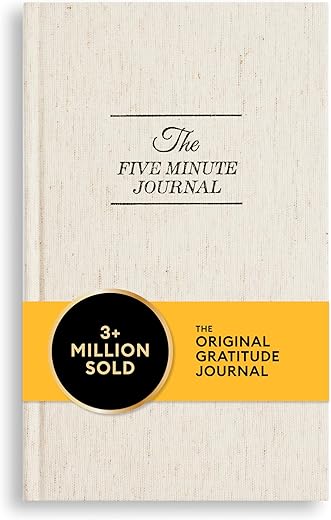
Which will actually change your brain in five minutes a day — a gratitude habit or a CBT thought‑debunking drill?
Ready to upgrade your mental toolkit? In this short guide you’ll get a clear side by side of the Five Minute Journal and a CBT Thought Record book so you can quickly decide which suits your daily routine and mental health goals. No degree needed.
Daily Gratitude
You’ll find this edition ideal if you want a low-friction, daily practice that nudges your mindset toward gratitude and intention. The guided morning and evening prompts make it easy to stay consistent, though it’s not a substitute for clinical therapy when you need deeper cognitive work.
Clinical Tool
You’ll get a functional, structured tool that supports cognitive restructuring and therapy homework without extra frills. It’s great for applying CBT techniques consistently, though it assumes you either know CBT basics or are working with a clinician.
Five Minute Journal
CBT Thought Record
Five Minute Journal
CBT Thought Record
Five Minute Journal
CBT Thought Record
What Each Product Is and How It Works
Intelligent Change Five Minute Journal — what it is and how you use it
You get an undated, prompt-driven gratitude and affirmation planner built for two quick check-ins each day. The layout gives short morning prompts (gratitude, what would make today great, daily affirmation) and brief evening prompts (what went well, how you could improve).
Typical session flow:
Who uses it and how fast you can start:
CBT Thought Record Book — what it is and how you use it
This is a 100-page worksheet-style workbook that follows classic CBT thought record steps: situation, automatic thoughts, emotions (with intensity), evidence for/against the thought, alternative thought, and outcome or behavioral plan.
Typical session flow:
Who uses it and how fast you can start:
Benefits, Evidence Base, and Intended Outcomes
Five Minute Journal — what it aims to accomplish
You use short daily prompts to cultivate gratitude, positive focus, and a simple habit of reflection. Research on gratitude journaling and brief positive psychology exercises shows consistent small-to-moderate improvements in daily well‑being, life satisfaction, and sleep quality when practiced regularly. Realistic outcomes: a clearer daily mood, fewer negative rumination episodes, and stronger habit formation. Expect a noticeable mood lift in days to a few weeks and more robust habit and mindset shifts after 4–8 weeks of regular use.
CBT Thought Record — what it aims to accomplish
You use structured worksheets to identify automatic thoughts, test evidence, and generate balanced alternative thoughts. Cognitive Behavioral Therapy (CBT) is one of the most extensively researched psychotherapies; thought records are a core CBT technique shown to reduce anxiety and depression by changing thinking patterns. Realistic outcomes: reduced intensity of distressing thoughts, clearer problem-focused plans, and symptom reduction. You can often feel immediate relief after a single effective reframe, with measurable symptom decreases over 6–12 weeks of regular practice or as part of a CBT course.
Which mental-health goals each supports
Practical expectancy and best fits
Features, Usability, and Practical Differences
Layout and prompts
The Five Minute Journal gives you guided morning and evening prompts on a single two-page spread per day: gratitude lines, daily affirmations, and brief reflections. The CBT Thought Record uses clinician-style fields: situation, emotions, automatic thoughts, evidence for/against, alternative thought, and outcome — each worksheet is focused on one incident.
Size, portability, writing space, durability
The Five Minute Journal measures about 8.7″ x 5.1″ with a linen hardcover and premium paper — it’s sturdy and sits nicely on your nightstand. Writing space is intentionally limited to short lines that keep entries brief.
The CBT Thought Record is roughly 8.5″ x 6″, paperback-style with 100 worksheet pages. It’s compact and lightweight for carrying to sessions and offers larger, structured areas for sustained writing on a single problem.
Undated vs fixed structure
The Five Minute Journal is undated and encourages daily habit formation without pressure — you can skip days and pick up anytime. The CBT workbook isn’t about calendar tracking; it’s a repeated, fixed worksheet format focused on processing specific events rather than daily moods.
Ease of use: busy days vs therapy sessions
If you’re short on time, the Five Minute Journal is quick and low-friction — useful on rushed mornings or bedtime routines. The CBT Thought Record requires more time and cognitive effort; it’s best when you’re working through a particular worry, doing homework from a therapist, or practicing a formal CBT exercise.
Privacy considerations
Both are private records, but thought records often include detailed, sensitive material about triggers and symptoms — consider storing the CBT workbook more securely. The Five Minute Journal tends toward lighter, gratitude-focused content but can still contain personal reflections you may want to protect.
Price and value on Amazon
The Five Minute Journal (~$29) gives a premium build and design that supports long-term daily use. The CBT Thought Record (~$9) is an affordable, practical tool for repeated therapeutic practice and homework.
When each format is more convenient
Feature Comparison Chart
How to Choose, Use, and Combine Them
Pick the right tool for your goal
If you want short, daily positivity work, choose the Five Minute Journal — it’s quick, habit-focused, and boosts gratitude and mood.
If you need to track, challenge, and reframe specific negative thoughts, choose the CBT Thought Record — it’s structured for therapeutic change and homework.
Simple sample routines
Morning routine (5–10 minutes):
Evening routine (10–30 minutes as needed):
Integrate with therapy
Track progress practically
When to switch or alternate
Customize prompts to fit you
Final Verdict — Which One Should You Pick?
For everyday happiness and habit-building, pick the Five Minute Journal — the clear winner for most people. If you’re tackling anxiety, depression, or distorted thinking, use the CBT Thought Record for structured symptom work. You can combine both: gratitude daily and thought records for targeted therapy. Ready to start?




Heads-up: the Five Minute Journal is undated which I love, but I missed a few days and felt guilty — lol.
CBT workbook is forgiving (just fill out when you need). If you’re streak-driven, get the journal; if you want flexibility, CBT.
Good practical tip, Hannah. The undated format is a feature for some, but can be a trap for others.
I use a habit tracker app alongside the journal so I don’t feel guilty about gaps.
Same here. I put stickers on missed days to remind myself gently, not shamefully 😂
Really liked this comparison — clear pros and cons. I use the Five Minute Journal in the morning and it legitimately sets my tone for the day. The CBT Thought Record is great for panic moments, though it’s more work.
If you want daily positivity with minimal effort go Five Minute. If you’re trying to reframe negative thinking patterns long-term, CBT wins.
Would love a follow-up comparing costs and digital versions!
Thanks for the feedback, Ethan — glad it resonated. A follow-up on digital vs printed versions is a great idea; I’ll add that to the list. Quick note: some people use both — journal in the AM, CBT sheets during tough evenings.
Agree with Ethan — I do a hybrid. Mornings with the Five Minute Journal, and when a thought spirals I pull out the CBT workbook. It’s surprisingly effective together.
Same here. Also cheaper to buy the CBT workbook once and photocopy pages when needed, if you go through them fast.
Short and honest: Five Minute Journal = feel-good ritual. CBT Thought Record = actual therapy homework.
Both have value but they serve different purposes. I prefer journaling for gratitude and CBT when anxiety spikes.
Yep. Also worth noting: CBT needs some guidance or examples at first, otherwise it can be confusing to fill out the thought record properly.
Great summary, Maya. We tried to highlight that distinction in the article — ritual vs technique — glad it came through for you.
Minor nit: the article didn’t highlight how much training helps with CBT. Without guidance it can feel like filling in blanks.
Still, the Thought Record book is a solid, cheap tool for anyone on a therapy journey.
Excellent point, Grace. We’ll update the article to emphasize the value of initial guidance for proper CBT use.
As a therapist, I always walk clients through the first few records. It makes a huge difference.
Noticed the CBT book is small (8.5″x6″) — portable and discrete, which I love. The Five Minute Journal is bulkier but nicer to leave on a bedside table.
Minor gripe: the CBT one could use more examples in the back. Otherwise solid.
Good point about portability. We mentioned the size differences but I’ll add a note about example density in the review.
I carry the CBT book in my bag. The small size makes it less intimidating in public 😅
I bought the Five Minute Journal as a gift and it was a huge hit. The quality feels premium and the prompts are simple.
That said, I’m a therapist and I keep recommending the CBT Thought Record to clients who want a structured way to challenge thoughts. Not as pretty, but so practical.
I do, Samira — for clients working on mood and gratitude. For OCD/anxiety I stick to CBT records.
Thanks for sharing that perspective, Olivia — it’s helpful hearing from a therapist who uses both in different contexts.
Great to see the practical crossover. Including use-cases like this might help others decide which to buy first.
Curious — do you ever give the journal to clients as part of therapy homework?
Lol I bought the journal expecting instant enlightenment. Spoiler: you still have to do the work 😅
That said, the prompts forced me to commit to one positive reflection and that stuck. CBT’s great for crisis-mode though.
Haha — instant enlightenment would be nice. Thanks for the laugh and honesty, Noah.
Right? No magic pens yet. But consistency helps more than intensity sometimes.
Funny thing: I thought I needed the Five Minute Journal to be happier but it turned out writing down one good thing a day made me notice patterns in what actually brings me joy. Little wins.
CBT records are for dark days. Two different tools, both worth owning imo.
Also, gratitude practice can improve sleep for me. So it’s not just ‘feel-good’ — has measurable effects.
Lovely observation, Priya. That noticing-and-pattern recognition is a subtle but powerful benefit of simple journaling.
Totally — noticing patterns changed my weekend planning. Who knew!
I tried both for a month each. Results:
– Five Minute Journal: better mood baseline, more gratefulness
– CBT Thought Record: fewer catastrophizing episodes, clearer evidence-based thinking
Honestly, you don’t need to choose forever. Rotate them based on your needs. 😊
Nice experiment, Sofia. Rotating tools is a smart approach — flexibility beats dogma in mental health practices.
How did you structure the rotation? Week-by-week or by need?
Liam — I did week-by-week for a month, then switched to ‘use CBT when a thought spike happens.’
For anyone on the fence: ask yourself whether you want a daily ritual (Five Minute) or a problem-solving tool (CBT). The former builds habit, the latter builds skill.
Also don’t underestimate the placebo/ritual effect — sometimes the feeling of doing something consistent helps more than the content.
And both can be used to reinforce each other! Habit builds the safety to tackle skills.
Agree — ritual can be therapeutic in itself. That’s why I stuck with the journal for months.
Well said, Daniel. Distinguishing habit-building vs skill-building is a helpful framework for readers choosing between the two.
Cost-wise: Five Minute Journal is pricier but looks nicer (giftable). CBT workbook is inexpensive and functional. Don’t overthink it — buy the one that fits your use-case.
Also pro tip: photocopy CBT pages if you need more space.
Yep — I got the Five Minute as a gift. Probably wouldn’t have bought it myself but glad I have it now.
Practical and to the point, Victor. Pricing and aesthetics do influence who buys what — great summary.
I’m all about actionable stuff — CBT Thought Record wins for me. Gratitude journals are nice but felt a bit surface-level when I was dealing with depression.
CBT helped me spot distortions and actually change how I responded. Not saying journaling is useless, just depends on goals.
Really appreciate you being candid — the distinction between ‘surface’ and ‘structural’ change is important.
Thanks for sharing your experience, Jared. That’s the kind of user insight that can help others pick depending on whether they’re seeking mood-lifting rituals or cognitive tools.
A bit of a nerdy take: CBT Thought Record aligns with evidence-based practice and is designed for cognitive restructuring. The Five Minute Journal draws from positive psychology.
So, they’re both legit but scientifically coming from different traditions. Pick the theory you trust 😉
I love the nerd angle. More science please 😄
Yup — that’s a helpful way to think about it. Thanks!
Nice succinct framing, Olga — theory matters, and many readers will appreciate knowing the evidence base behind each tool.
I appreciated the layout comparison. Visuals matter: the Five Minute Journal has beautiful design and feels like a ritual. The CBT book is utilitarian, which is exactly what some people need.
Would love to see a printable CBT thought record template linked in the article.
Thanks, Aisha — we can definitely add a printable template. Good idea to cater to both aesthetic and functional preferences.
If you want a quick template I can upload one I made — it’s bare-bones but functional.
Victor — that would be awesome. If you’re willing, DM or email it and we’ll include it with credit.