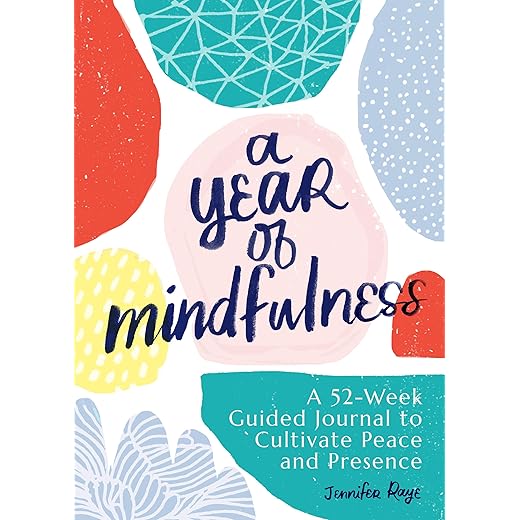
A tiny, structured journal that makes daily mindfulness achievable — especially for beginners.
Feel like you never have time to be present? You’re not alone — busy days and lofty expectations turn most mindfulness plans into abandoned to-do’s. A Year of Mindfulness uses bite-sized, daily prompts across 52 themed weeks to make building a routine actually doable, even when your schedule is packed.
If you want a simple, structured way to practice without long writing sessions, this compact guided journal is a friendly nudge toward consistency. It’s affordable and approachable for beginners, though if you love long-form reflection or heavy-ink entries you might find the space and paper a bit limiting.
You’ll find this journal makes forming a daily mindfulness habit simple and manageable, with short prompts that gently guide you through a year of practice. It’s especially well suited to newcomers or anyone who wants a structured, low-pressure way to become more present, though long-form journalers may want more writing space.
Paper is decent but could be thicker for heavy ink users
Limited space for long-form writing or deep reflection
Some prompts are simple/repetitive for experienced meditators
Overview
You’re holding a practical, yearlong map to make small moments of presence part of everyday life. This guided journal divides 52 weeks into themed sections with seven unique prompts per week (364 prompts total), so you don’t have to invent what to reflect on — you just show up. The emphasis is on short, actionable exercises that fit into busy routines, helping you reduce negativity and grow your sense of calm over time.
Who this is for
This journal is for you if any of the following sounds like you:
You want a gentle, consistent mindfulness practice without a complicated regimen
You prefer short, clear prompts rather than long-form therapy-style journaling
You’re buying a meaningful, practical gift for a friend or family member
You want an introduction to different aspects of mindfulness (breath, body, nature, routines)
What’s inside — structure and features
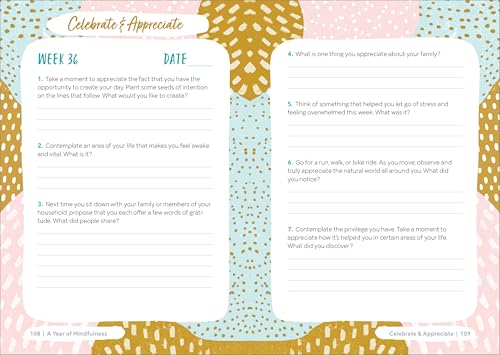
The journal’s content is organized to make weekly focus accessible and cumulative. Each week has a theme and each day offers a distinct prompt tied to that theme, so you can explore a single area deeply over seven days before moving on.
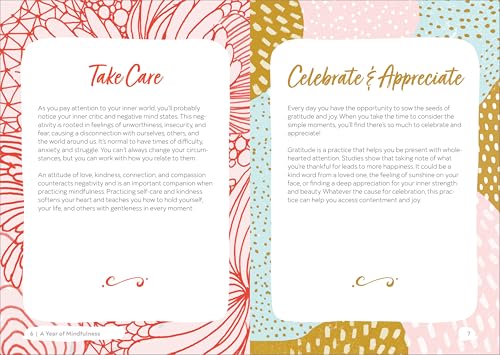
Weekly themes include body awareness, connecting with nature, gratitude, mindful movement, self-compassion, daily chores as practice, and more.
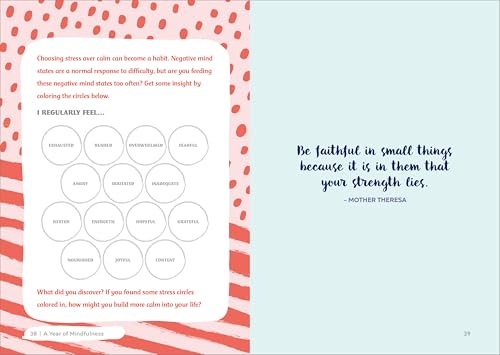
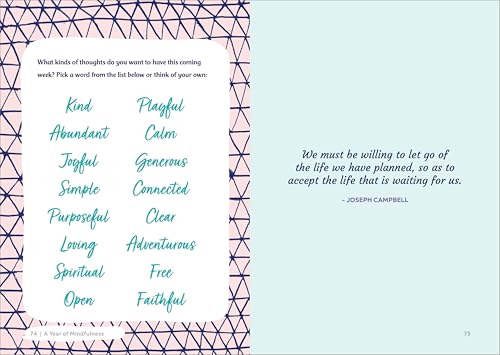
Daily prompts are short and specific — sometimes reflective questions, sometimes simple practices (a breathing check-in, a short observation task, a gratitude micro-list).
Space is provided after every prompt for a short written response, making this ideal for 5–15 minute sessions.
Typical weekly layout (what you’ll see)
Component
Purpose
Weekly theme header
Orients you to the focus for seven days
7 daily prompts
Keeps practice varied while centered on the theme
Short writing space
Encourages quick reflection without intimidation
Occasional tips
Practical reminders or mini-exercises you can reuse
Practical benefits you’ll notice
Developing routine: Because prompts are short and predictable, you can tether the practice to a daily habit (morning coffee, before bed, lunch break).
Expanded awareness: Themes nudge you to notice parts of life you might otherwise ignore — how your body feels, what nature looks like, or how chores can be a practice.
Reduced decision fatigue: You don’t need to decide what to reflect on; the journal provides a structured path across 52 weeks.
Giftability: The compact, approachable format makes it an easy, thoughtful present for someone starting a mental wellness journey.
How to use it (suggested routines)
Short daily: Spend 5–10 minutes answering the prompt and noting one small takeaway.
Deep weekly: Pick one day each week to expand on that week’s theme with a longer entry or an offline practice (walk, photo project, or breathing session).
Micro-practices: Use the suggested mini-exercises (2–5 minute breathing checks, sensory scans) during stressful moments.
Design & physical notes
The journal is designed to be approachable rather than luxurious. Pages are laid out with legible type and modest margins — enough room for a few sentences or a short paragraph per prompt. The binding and cover are sturdy enough for daily handling and gift presentation.
Size: Portable — easy to carry in a bag or keep on a nightstand.
Paper: Functional and smooth, suited for pencils and most pens, though heavy, bleed-prone markers may show through.
Durability: Built for everyday use for a full year; treat it as a personal object you’ll return to often.
What to expect over the year
The experience is cumulative rather than intensive. You won’t get dramatic epiphanies every day, but you will build a habit of noticing. Over weeks and months you’ll likely notice:
Greater ease in redirecting attention away from worry and into the present
New, small rituals that provide daily relief (a breathing check or a nature photo habit)
A clearer awareness of patterns in mood, reactivity, and what brings you calm
Strengths and trade-offs
Strengths: Highly accessible prompts, a clear progression of themes, and a format that supports consistency without pressure.
Trade-offs: If you prefer long-form introspective journaling or deep therapeutic exercises, the space and prompt depth can feel limited. You may want to pair this journal with a separate notebook for extended entries.
Quick start checklist
Choose a consistent time of day to write (morning, lunch, or evening).
Commit to 30 days as an experiment to build habit.
Combine a daily prompt with one tiny related action (5-minute walk, breathe for 3 minutes, photograph something beautiful).
Final thoughts
This yearlong guided journal is a companion designed to scaffold a gentle, sustainable mindfulness practice. It’s ideal for beginners, busy people, and gift-givers who want a simple but structured way to bring more presence into daily life. You’ll get out of it what you invest: small daily steps here lead to subtle but meaningful shifts in how you notice and respond to your world.
Can I use the journal if I’ve never tried mindfulness before?
Yes — it’s beginner-friendly and designed to be approachable.
The journal is organized into 52 weekly themes and contains 364 short prompts, so you move step by step. Many exercises are tiny and practical, such as a 3–5 breath check-in or a one-minute sensory notice. These are simple to follow without formal meditation training.
You can start by trying one of these quick techniques:
Take 3–5 slow, deep breaths. Inhale for a count of 4, pause briefly, then exhale for a count of 4.
Spend 60 seconds naming five things you can see, four you can touch, three you can hear, two you can smell, and one you can taste.
These short practices help build attention and calm so you can expand gradually as you feel ready.
How much time do I need to commit each day?
Most prompts fit into a 5–15 minute window. The book was made for short daily habits so you can be consistent.
You can adapt the time to your schedule:
3–5 minutes: a quick check-in (breathing, a single prompt, or a sensory pause).
5–15 minutes: the typical prompt length for a meaningful micro-practice.
20+ minutes: use longer reflection or a full meditation session on days you want deeper work.
Use a timer or place the practice with an existing routine (morning coffee, lunch break, bedtime) to make it easier to stick with.
Is this journal suitable for gifting to someone in recovery or therapy?
Yes, with some caution. The prompts are gentle and aimed at daily presence, which can support recovery and therapy goals.
Keep these points in mind:
If the person is currently processing intense trauma, some prompts could feel triggering. Check with their therapist or caregiver first.
The journal can complement therapy by encouraging grounding and emotion-regulation skills, but it is not a replacement for professional treatment.
If you gift it, consider adding a note suggesting they use whatever feels safe and skip anything that causes distress.
What should I do if a prompt feels boring or irrelevant?
Treat prompts as invitations, not rules. You can skip, adapt, or reinterpret them to fit your life.
Practical options:
Reframe the prompt as a small experiment (e.g., notice how a boring task changes when you slow down).
Change the sense you focus on (swap an observation prompt for a short walk or a listening exercise).
Time-box it: give yourself 3–5 minutes and observe what comes up, then stop.
These tweaks keep the habit without forcing you into exercises that don’t land.
Can I use this alongside a meditation or therapy practice?
Absolutely. The journal is designed to reinforce skills you learn in meditation or therapy.
Ways to combine them:
Use daily prompts as between-session homework to practice tools taught in therapy.
Log patterns, triggers, and small wins to bring to your therapist or meditation teacher.
Use it to track mood and habits over weeks so you can spot trends and adjust techniques.
How do I keep the habit going after the year ends?
Keep what worked and simplify the rest. The goal is to keep a few reliable micro-practices you enjoy.
Try this plan:
Review the year and pick 2–3 prompts or practices that helped most.
Create a condensed weekly routine using those micro-practices (for example: two 5-minute check-ins during the week and a longer 20-minute practice on weekends).
Use reminders, a simple checklist, or a habit app to keep momentum. Do a brief monthly review to tweak the routine.
Is there enough space for people who like to write long entries?
The journal favors brevity to encourage daily consistency. The page layouts are intended for short reflections.
If you want longer writing:
Keep a companion notebook or digital doc for deep dives and longer journaling.
Use the journal for quick daily prompts and the companion for extended processing after your short check-in.
This approach preserves the ease of daily practice while giving you room for fuller reflection.
Curious whether the journal addresses weekends differently or if it’s strictly one prompt per week. I commute a lot and wonder how flexible the structure is.
The format is one prompt per week with daily micro-prompts you can use flexibly. Many readers skip days or pick prompts when it suits them — it’s meant to be non-dogmatic.
Short, structured prompts feel a bit like homework to me, not gonna lie. I like mindfulness but prefer unguided practice. That said, I can see it helping beginners.
Fair point, Henry. The journal is definitely geared toward guided practice; it’s not for everyone but many new practitioners find the structure useful.






I do wish there was an index or monthly summary page to track themes. Otherwise the prompts are thoughtful and varied.
A monthly reflection page would be perfect. I ended up making my own inserts.
Great suggestion, Li. Several readers have asked for monthly summaries — we’ll pass that along for future editions.
Thanks for the tips — will try the inserts idea.
Same — I tape in a simple calendar at the end of each month.
Curious whether the journal addresses weekends differently or if it’s strictly one prompt per week. I commute a lot and wonder how flexible the structure is.
I just treat the prompts as options. If I’m on the road, I do a short version on my phone or jot a word during a coffee stop.
Nice, thanks — that sounds doable.
The format is one prompt per week with daily micro-prompts you can use flexibly. Many readers skip days or pick prompts when it suits them — it’s meant to be non-dogmatic.
I have to admit — skeptical at first. Another ‘fix your life in 5 minutes’ product, right? But I gave it a shot because of the 52-week structure.
Week 1 prompt was simple: notice one thing today. That got me journaling a tiny bit each night.
After three months I actually felt a shift in how I pause between work tasks. Not dramatic, but steady.
Not a replacement for therapy or deep reflection, but a realistic daily practice for busy people.
If you’re into long-form stream-of-consciousness, you’ll be a bit cramped, but for habit-building it’s gold.
Thanks for the honest take, Daniel. That’s exactly the use case we had in mind — small, sustainable practice rather than deep-dive journaling.
This makes me actually want to try it. Thanks for sharing the timeline!
Usually 2-4 sentences. Fits fine. Some weeks I doodle too.
Love this perspective — ‘not dramatic, but steady’ is a perfect summary.
How long do your entries usually end up being? I’m worried my handwriting won’t fit 😅
Price point of $7.13 is a steal. Was worried about quality but the paper is decent. The prompts are varied and not cheesy.
Short, structured prompts feel a bit like homework to me, not gonna lie. I like mindfulness but prefer unguided practice. That said, I can see it helping beginners.
Fair point, Henry. The journal is definitely geared toward guided practice; it’s not for everyone but many new practitioners find the structure useful.
If you’re a long-form writer, skip this. If you’re someone who needs a nudge to start, buy it. Plain and simple.
Exactly — think of it as a spark, not the whole bonfire.
This is the right TL;DR. I use it as a prompt engine and then write more in a notebook.